Step-by-step guide
Massachusetts Non-Resident Guide
How a New York resident gets a Massachusetts Non-Resident Temporary License to Carry Firearms.
Where You Can Carry — See the Map
Massachusetts Gives Non-Residents a One-Year License from the State Police Records Bureau. You Must Take a Massachusetts Safety Course and Go Once in Person to Chelsea, MA.
At a glance (checked Nov 1, 2026):
Can a New Yorker apply? Yes. The license is the Non-Resident Temporary License to Carry Firearms, issued by the Firearms Records Bureau (FRB)
Training: A Massachusetts Basic Firearms Safety Course certificate from a Massachusetts State Police certified instructor (some are based in New York)
Fingerprints: A fingerprint-based background check is part of processing
In person: Yes, once. Every first-time applicant must appear at the FRB in Chelsea, MA, by appointment. Renewals are online or by mail
Cost: $100 (not refunded)
Processing: No official time given; the license is mailed to you
Valid for: 1 year, with no grace period. You must renew every year
Step 1 - Check That You Qualify
Any non-resident can apply to the Firearms Records Bureau, which issues non-resident licenses for the Colonel of the State Police (Massachusetts law, chapter 140, section 131F).
You must not be a "prohibited person" and must not be found "unsuitable." The application asks about arrests, court cases, restraining orders, mental health commitments, and any firearms license that was ever suspended, revoked or denied. Answer fully; a false answer is a crime.
A New York carry license is not required by the law, but the form asks which other states have licensed you.
Non-resident business owners can no longer get a regular Massachusetts LTC; non-residents use this temporary license. For more information click here
Step 2 - The Massachusetts Safety Course
First-time applicants must send a copy of a Massachusetts Basic Firearms Safety Course certificate. The instructor must be certified by the Massachusetts State Police. Ask the instructor before you sign up. For more information click here
The State Police publish the approved course list and a public list of certified instructors. The October 1, 2026 instructor list includes some instructors based in New York (for example on Long Island, in Westchester and in Orange County), so you may not need to travel for the class. For more information click here
What changed in 2026: under the 2024 gun law (Chapter 135), courses taken on or after April 2, 2026 must also cover suicide prevention, use-of-force law and conflict avoidance, and the law calls for live-fire training. The live-fire rules were not final, and the state said that until they are, live fire does not need to be included. A course you took before April 2, 2026 is still accepted. For more information click here
No course is needed if you held a Massachusetts resident or non-resident license on or after June 1, 1998.
Step 3 - The Application
Online (recommended): apply through the MIRCS Unified Gun Portal. Online applicants can pay online. For more information click here
By mail: download the Non-Resident Temporary License to Carry application (revised May 2026), fill it in and sign it. For more information click here
Include: the safety course certificate, a valid home address (no P.O. box), a self-addressed stamped envelope for the license, and, if you are a naturalized citizen or green card holder, the immigration documents the form lists.
On the form you can ask for your in-person appointment date to be emailed to you; otherwise it comes by mail.
Step 4 - Fee, Mailing and the in-Person Visit
Fee: $100, not refunded. By mail, pay only by bank check or postal money order made out to "Commonwealth of Massachusetts". Cash, personal and business checks are returned.
Mail the package to:
Massachusetts Department of Criminal Justice Information Services
Firearms Records Bureau
200 Arlington Street, Suite 2200
Chelsea, MA 02150
In person: every first-time applicant must appear at the FRB in Chelsea. There are no walk-ins; the FRB contacts you with an appointment date after it receives your application.
Processing includes state and federal background checks, a fingerprint-based check and a Department of Mental Health check. For more information click here
Step 5 - After You Apply
The license is mailed to you. To check status, look in your portal account or call the FRB at (617) 660-4782.
Valid for 1 year from the date of issue, with no grace period. Apply to renew at least 90 days before it expires. Renewals are online or by mail and do not need a trip unless the FRB asks.
Renewals also need the lost or stolen firearms affidavit that is part of the form.
Report any change of address through the portal within 30 days, or the license may be suspended or revoked. For more information click here
Where It Is Valid
Not valid in New York, New Jersey, Connecticut, Maryland, Pennsylvania, California or Washington, DC.
Many states honor only out-of-state permits held by residents of the issuing state. For example Florida, Michigan, Colorado and Pennsylvania do not honor a non-resident permit.
From our research, among states that require a permit, Minnesota, Nevada, North Carolina, Virginia and Wisconsin honor a Massachusetts permit held by a non-resident. Minnesota honors Massachusetts permits only if issued or renewed on or after August 1, 2024. Many other states let visitors carry without a permit anyway. Check the map and each state's own list before you travel.
Good to Know
You cannot buy guns or ammunition in Massachusetts with this temporary license. For more information click here
Magazines: a "large capacity" magazine (more than 10 rounds) is legal only if made before September 13, 1994. The law also says a large capacity firearm may be carried only if your license clearly says so. Bring only 10-round magazines. For more information click here
Places you cannot carry: schools, colleges and universities (buildings, grounds and school transport) without written permission; government buildings used for administration, courts or corrections, including their grounds and parking; and polling places and early voting sites while open, and within 150 feet of the entrance. For more information click here
In a car: when the gun is not under your direct control it must be secured. A locked car by itself does not count; a locked glove box, locked console, locked case or a trunk you cannot reach from the seats does. For more information click here
Just driving through without a Massachusetts license? State law lets a non-resident carry a gun on their person while in a vehicle traveling through the state, as long as it stays in the vehicle and is secured when not under direct control. Driving to work in Massachusetts does not count as traveling through. Brief stops for the trip appear to be allowed. For more information click here
Rules may change soon: on November 3, 2026 Massachusetts votes on Question 9. A "yes" vote keeps the 2024 gun law (Chapter 135); a "no" vote repeals it. Check back after the vote. For more information click here
Every state has different laws pertaining to carrying, restrictions etc. It is your responsibility to know these laws and be familiar with them before visiting that state.
This guide summarizes the state's published instructions as of November 1, 2026 and is not legal advice. Fees, forms and rules change; always check the official page before you apply. Tips from others' experience come from users on the chats; they are personal experiences, not official rules.
Official Sources
Checked November 1, 2026.
Mass.gov (Department of Criminal Justice Information Services), Apply for or renew a firearms license (non-residents apply to the FRB, $100, valid 1 year, no grace period, mailing address, processing). For more information click here
Firearms Records Bureau, Non-Resident Temporary License to Carry application and instructions (revised May 2026): in-person first appearance, fee, safety course, renewal. For more information click here
MIRCS Unified Gun Portal (online application). For more information click here
Massachusetts State Police, Firearms Safety Instructors Certification Program (approved courses and certified instructors). For more information click here
Executive Office of Public Safety and Security, memo on new Basic Firearms Safety courses (March 26, 2026). For more information click here
Executive Office of Public Safety and Security, An Act Modernizing Firearm Laws, Guidance #5 (September 18, 2026). For more information click here
Mass.gov, Firearms license and transaction FAQ (non-resident LTCs, large capacity magazines). For more information click here
Massachusetts General Laws, chapter 140, section 131F (non-resident temporary license). For more information click here
Massachusetts General Laws, chapter 140, section 129C (non-residents traveling through). For more information click here
Massachusetts General Laws, chapter 269, section 10 (schools, prohibited areas, large capacity). For more information click here
Secretary of the Commonwealth, 2026 Ballot Question 9. For more information click here
Where You Can Carry
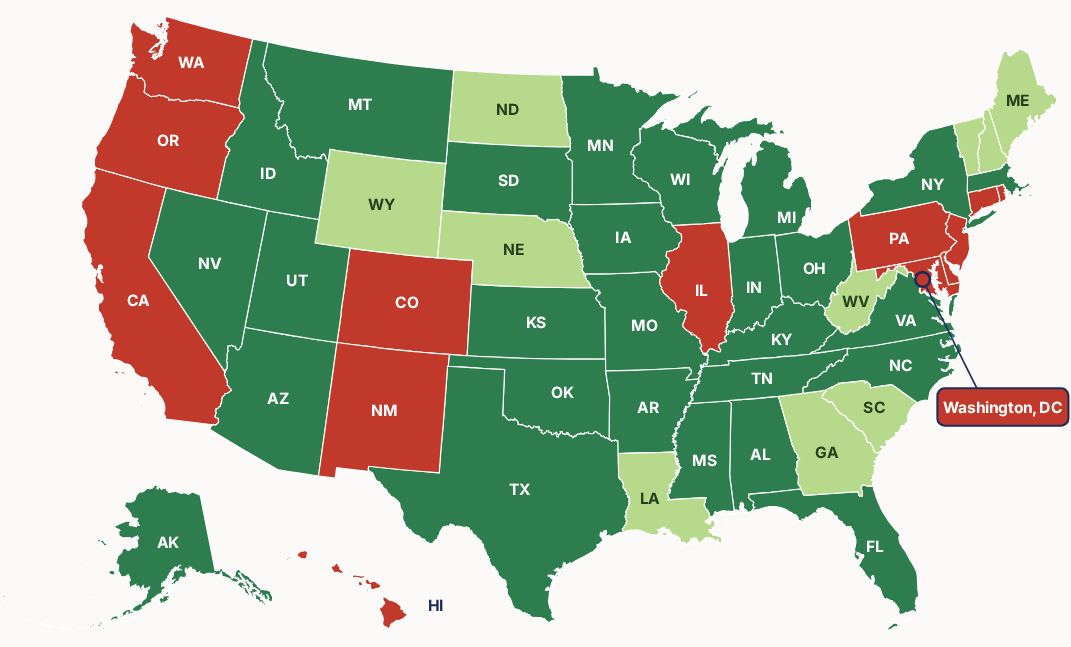
You Cannot Carry in These States (14)
California, Colorado, Connecticut, Delaware, Hawaii, Illinois, Maryland, New Jersey, New Mexico, Oregon, Pennsylvania, Rhode Island, Washington State, Washington, DC
Dark green: you can carry. Your licenses are honored there (or it is the state that issued the permit).
Light green: you can carry with no permit. That state lets visitors carry with no permit at all. Age limits and rules apply.
Red: you cannot carry here. None of your licenses is honored there, and visitors may not carry without one. Do not carry.
Washington, DC does not recognize any other state's license — you need a DC Concealed Carry Pistol License.
Virginia: changes July 1, 2027 — a new law (SB 115) replaces honoring all states with an Attorney General list not yet published.
Before You Travel
- Check every state on your route. Read the official state police or attorney general website for each state you will pass through. Laws change, and this map can fall behind.
- Verify your exact permit type is honored. Many states honor only permits issued to residents of the issuing state, not non-resident permits.
- Resident vs. non-resident rules differ. A state may treat the same permit differently depending on where you live.
- Permitless carry has limits. Some permitless-carry states allow it only for their own residents, or only from a certain age.
- Review each state's carry laws. Know where carry is banned (schools, government buildings, bars, parks, transit and more) and the rules for carrying in a car.
- Duty to inform. Some states require you to tell a police officer right away that you are carrying.
- Ammunition. Some states restrict hollow-point ammunition (for example, New Jersey). Check what you may carry.
- Magazine capacity. Magazine limits differ by state.
- Type of firearm. Some places ban certain firearms (for example, AR-style rifles are not allowed in New York City).
- Interstate travel (safe passage). Under federal law, 18 U.S.C. § 926A (part of the Firearm Owners Protection Act of 1986, signed by President Reagan), you may transport a firearm through a state where you cannot legally carry, if you may lawfully possess and carry it at both your starting point and your destination. The firearm must be unloaded, and neither the firearm nor any ammunition may be readily accessible from the passenger compartment: keep them in the trunk, or, in a vehicle without a trunk, in a locked container other than the glove compartment or console. Stops along the way can complicate this protection, so verify before you travel. Read 18 U.S.C. § 926A
Checked November 2026. Laws change: always verify before you travel. This is general information, not legal advice.
Last checked: November 1, 2026
New to the terms? See the 2A Glossary.

You Carry the Responsibility. We Carry the Process.
The decision to carry is yours. The stress of getting approved doesn't have to be. White Glove is a full service: we handle the process with you, make sure every requirement is met 100%, and stay with you to the finish line. Every completed application we've handled has been approved.
- Full service - we take the stress of doing it all
- Every requirement checked and met, 100%
- We Prepare and Submit All Your Paperwork
- Notary services available*
- Your 18-hour training scheduled
- We Prep You for the Fingerprinting and Interview Appointment
- Guided step by step - and We Assist You Once You're Approved
Join the 2A613 Community
Take our community survey and subscribe to updates. We only email about important topics and never sell your email to third parties.
Take the survey